


We’re happy to announce the completion of Cohere+, a 3-year EU-funded project which focused on mapping the ecosystem of transformative social change initiatives in Europe, and supporting changemakers to build capacities for coherent collective action in response to metacrisis.
This project, running from September 2022 to August 2025, was a partnership between five European organisations: Life Itself (France), Emerge (Germany), the Ekskäret Foundation (Sweden), the Institute for Integral Studies (Germany), and The Hague Center for Global Governance, Innovation, and Emergence (Netherlands).
If you’re a practitioner in the field of inner-led change, or curious to learn more about this ecosystem, read on for some of the project highlights and to access some of the essays, reports, and free educational resources created as part of this project.
Surveying the field
Mapping the ecosystem of “paradigmatic social change” initiatives in Europe and beyond
Life Itself led the research and ecosystem mapping portion of the project, creating a directory and interactive visual map of 300+ organisations and initiatives taking action for transformative, deep-rooted, or regenerative social change in Europe and beyond.
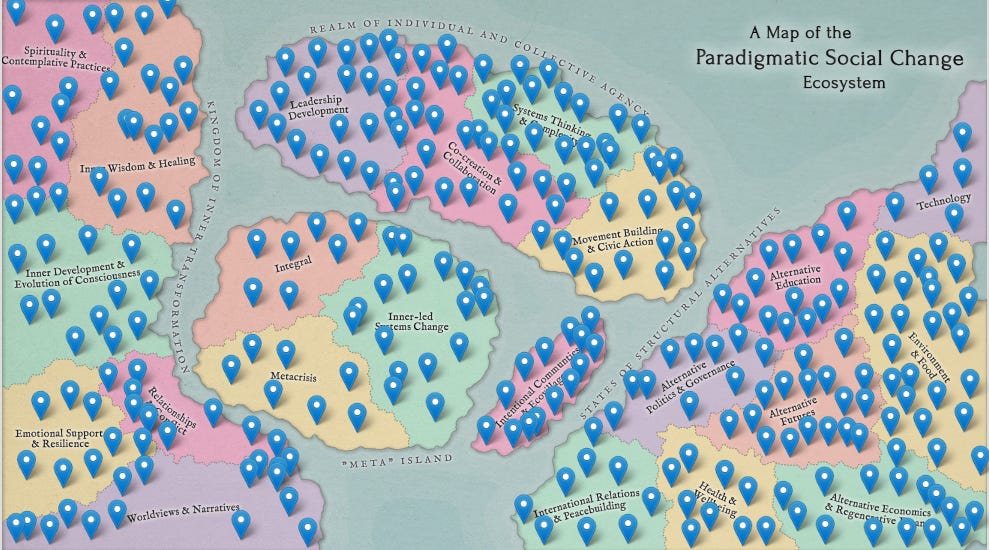
You can add or edit profiles in the map following the instructions in our contributors’ guide, or suggest an organisation to be included in future iterations of mapping here. We’d also love to hear your feedback on the map via this forum discussion.
Please note: our research team made their best effort to select and represent organisations accurately using publicly available information. We apologise if there are any inaccuracies. We welcome both direct edits and any feedback, so that the map may grow and improve thanks to collective intelligence.
Making sense of a novel and emerging landscape
Drawing on our mapping research from both this project and previous years’ work (Life Itself have been mapping this ecosystem since 2020), we wrote three essays to help newcomers and explorers begin making sense of this diverse and rapidly evolving field, supporting the ecosystem to become more recognisable and accessible:
An overview of different names used to refer to the ecosystem
‘The Second Renaissance: A Very Short Introduction’ (an introduction to “Second Renaissance” as a framing for the growing network of people and organisations who are acting to steward and accelerate a new cultural paradigm, in response to profound current crises)
Diving deeper
Research report: Investigating inner capacities needed for changemakers to respond to the crises of our times
Life Itself interviewed leaders from across the ecosystem to investigate: what inner capacities do change agents in the emerging ecosystem need to develop to enhance the ecosystem’s collective capacity to contribute to life-serving socio-ecological transformation?
Synthesising our interview findings, we identified three key ecosystem-level challenges: 1) Developing healthy relational cultures; 2) Cultivating emergent ways of working together; and 3) Reckoning with dominant cultural paradigms.
We then outlined six key “capacities for the future” that individuals and groups within the ecosystem should focus on developing:
Ease with uncertainty and complexity
Critical inquiry into existing mental structures
Addressing reactivity, tension, and conflict
Agency and capacity to implement vision
Acting in service of the greater whole
Collective inner resourcing
Read the full report here: Catherine Tran and Elisa Paka, 'Emergent Power: Key Challenges and Capacities for Paradigmatic Change Agents' (2024).
Profiles of visionary changemakers and essays on methodologies for transformative social change
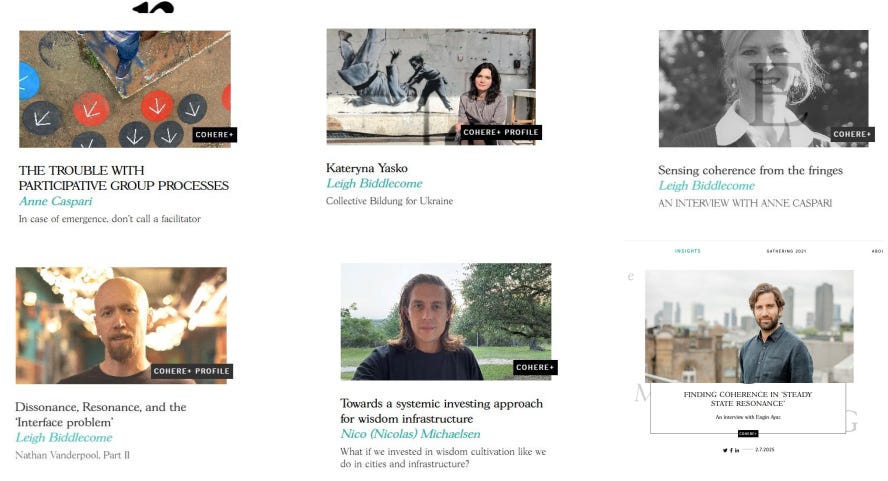
Cohere+ project partner Emerge dug deeper into some of the pioneering work and rich learnings from around the ecosystem in a series of profiles and essays.
Highlights include:
Anne Caspari on ‘The Trouble with Participative Group Processes’
Emily Poel on ‘Embodiment as a “Door to Presence and Possibilities”’
A multi-voice profile of the Cohere+ project team, ‘Reflecting Back on a Three-Year Investigation of Coherence’
See the full list of articles and essays here.
Field building
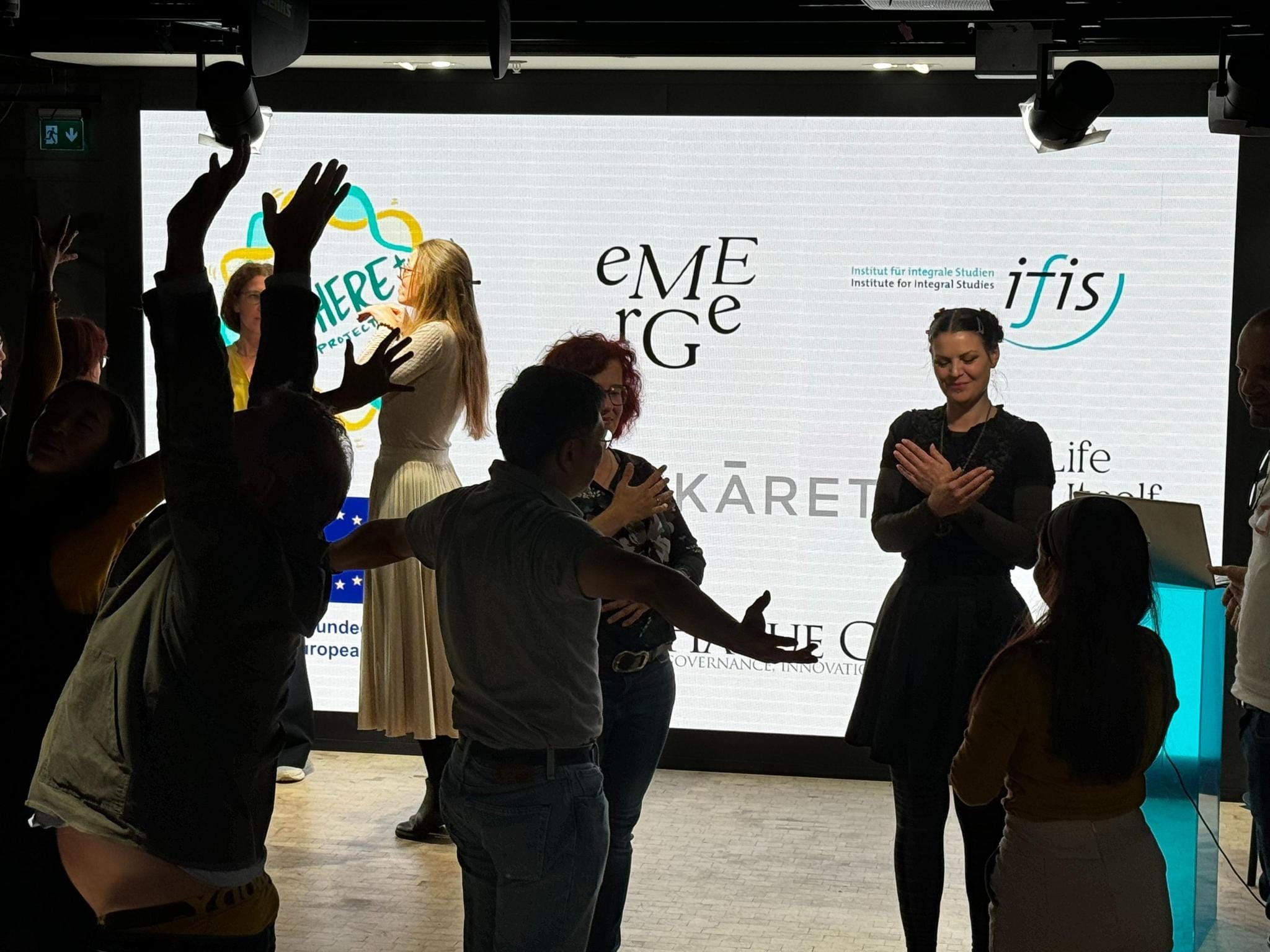
The Cohere+ project partnership convened a wide range of in-person and online learning exchange and field building activities, from: Integral Political Salons, which invited transnational conversations about more holistic ways of doing politics and explored existing case studies; to generative dialogue sessions for civic action in Germany; to hosting workshops which integrated playful creativity with dialogue to support attendees to digest a rich conference experience at the Inner Development Goals Summit in Stockholm in 2023 and 2024.
Educational resources
An online learning platform to develop “capacities for coherence”
Cohere+ project partners The Hague Center and the Institute for Integral Studies led the development of a free online learning portal to empower changemakers to develop their capacities for individual and collective coherence.
Drawing on the findings of the aforementioned research report by Life Itself, which identified key “capacities for the future” for changemakers in the ecosystem, the Cohere+ team developed self-paced mini-courses in five key learning series: Personal Coherence; Wise Relating; Communities of Coherence; Social Architecture; and Collective Voice and Impact.
A guide to coherence and its role in creating effective systemic change
The Cohere+ project team published a guide exploring the nature of coherence and its potential for supporting the global movement of paradigmatic systems change: Communities of Coherence: A Guide for Practitioners (lead author: Claudine Villemot-Kienzle).
The guide identifies factors that support or prevent coherence in individuals and communities involved in regenerative societal transformation; and offers tools and practices for building capacity to consciously design social contexts for the manifestation of coherence.
Read the full guide here.
